
68th Annual Meeting of the Permanent International Altaistic Conference
Hosted by
Sanskrit Studies Centre, Faculty of Archaeology,
Silpakorn University
and
Center for Korean Studies, Institute of East Asia Studies,
Thammasat University
21–26 June 2026
at Sanskrit Studies Centre
8 Suparbburut Road, Thaweewattana District, Bangkok,
Thailand, 10170
Report
by
Oliver Corff
Introduction
For the first time in the history of the PIAC, Thailand hosted a PIAC Meeting. Thanks to a suggestion by Juha Janhunen in 2025, a group of younger PIAC members with affiliations in Finland and Thailand organized this year’s Annual Meeting at the Sanskrit Studies Centre, Faculty of Archaeology, Silpakorn University, in collaboration with the Center for Korean Studies, Institute of East Asia Studies, Thammasat University, with Prof. Sombat Mangmeesukhsiri, Director of the Sanskrit Studies Centre, as President of the 68th Annual Meeting.
Opening Ceremony
The 68th Annual Meeting began with a welcome speech by Sombat Mangmeesukhsiri. After his speech, a group of students of the Sanskrit Studies Centre chanted Buddhajayamaṅgala Gāthā and Jaya Paritta.
Chirapat Prapandvidya, the founding director of the Sanskrit Studies Centre, and Putsadee Rodcharoen, Deputy Dean for Student Development, Faculty of Archaeology, Silpakorn University, also welcomed the Participants of the 68th Annual Meeting. The final speech was delivered by Oliver Corff, Secretary General of the PIAC.
In his speech, he explained the multitude of considerations which accompany the process of selecting a host institution and country. Besides traditional centres of Altaic Studies (e.g. in Germany, Hungary, Japan, the USA, Russia et al.), representatives of the Altaic heartlands such as Kyrgyzstan and Kazakhstan come to mind as potential hosts. Yet there are also considerations that have nothing to do with the subject of Altaic studies. For instance, in 1972 the choice fell on Strebersdorf near Vienna, Austria, because in the bipolar world of the Cold War Austria was a neutral country which made it possible for scholars like Nicholas Poppe to participate as he could not travel to countries of the Eastern Bloc, like the former GDR (12th Annual Meeting, Berlin 1969) and Hungary (14th Annual Meeting, Szeged 1971).
Returning to the world of Altaic studies, the choice of Thailand offers an excellent opportunity for opening a completely new perspective onto the relationship between the Altaic World and Southeast Asia. It deserves to be mentioned that Mongolia as one of the countries at the core of Altaic studies has been enjoying a long-standing tradition of exchanges with India, a rich Buddhist tradition, and, last but not least, has several traditional scripts which are all based on Abugida scripts: ‘Phags-pa, Zanabazar Square (also known as Horizontal Square) and Soyombo, which are closely modelled after Tibetan, Rañjanā and Devanagari.
A minute of silence was held for:
Bernt Brendemoen (* January 10, 1949 — † March 9, 2024)
Kakuk Zsuzsa (* August 13, 1925 — † April 18, 2025)
Larry Vernon Clark (* July 19, 1943 — † September 23, 2025)
Klaus Sagaster (* March 19, 1933 — † November 11, 2025)
Lars Johanson (* March 8, 1936 — † November 24, 2025)
Klaus Koppe (* February 06, 1956 — † November 27, 2025)
Martin Gimm (* May 25, 1930 — † December 22, 2025)
Münevver Tekcan (* 1966 — † March 5, 2026)
The Secretary General then explained the current situation of the PIAC Prize for Altaic Studies. Unfortunately, the PIAC Prize for Altaic studies, colloquially known as the PIAC Medal, could not be awarded in 2026. While there are precedents of years without awarding the PIAC Prize for Altaic Studies, the main reason for not awarding the PIAC Medal in the current year lies in the cost of procurement which has risen dramatically since the new PIAC Medal was conceived in 2017 at the Business Meeting of the 60th Annual Meeting of the PIAC in Székesfehérvár. The share of the cost per capita would have increased the contribution fee to unacceptable height due to this year’s fairly small number of participants.
Confessions
During the confessions, 29 participants (or 34 participants if all part-time participants from Thailand are included; see List of Participants) from 13 countries (Czech Republic, Finland, France, Germany, Hungary, Japan, Kazakhstan, Russia, Sweden, Thailand, Turkey, Turkmenistan and USA) introduced themselves and their current work. This comparatively small number of participants proved to be beneficial for in-depth discussions of individual communications during the panels.
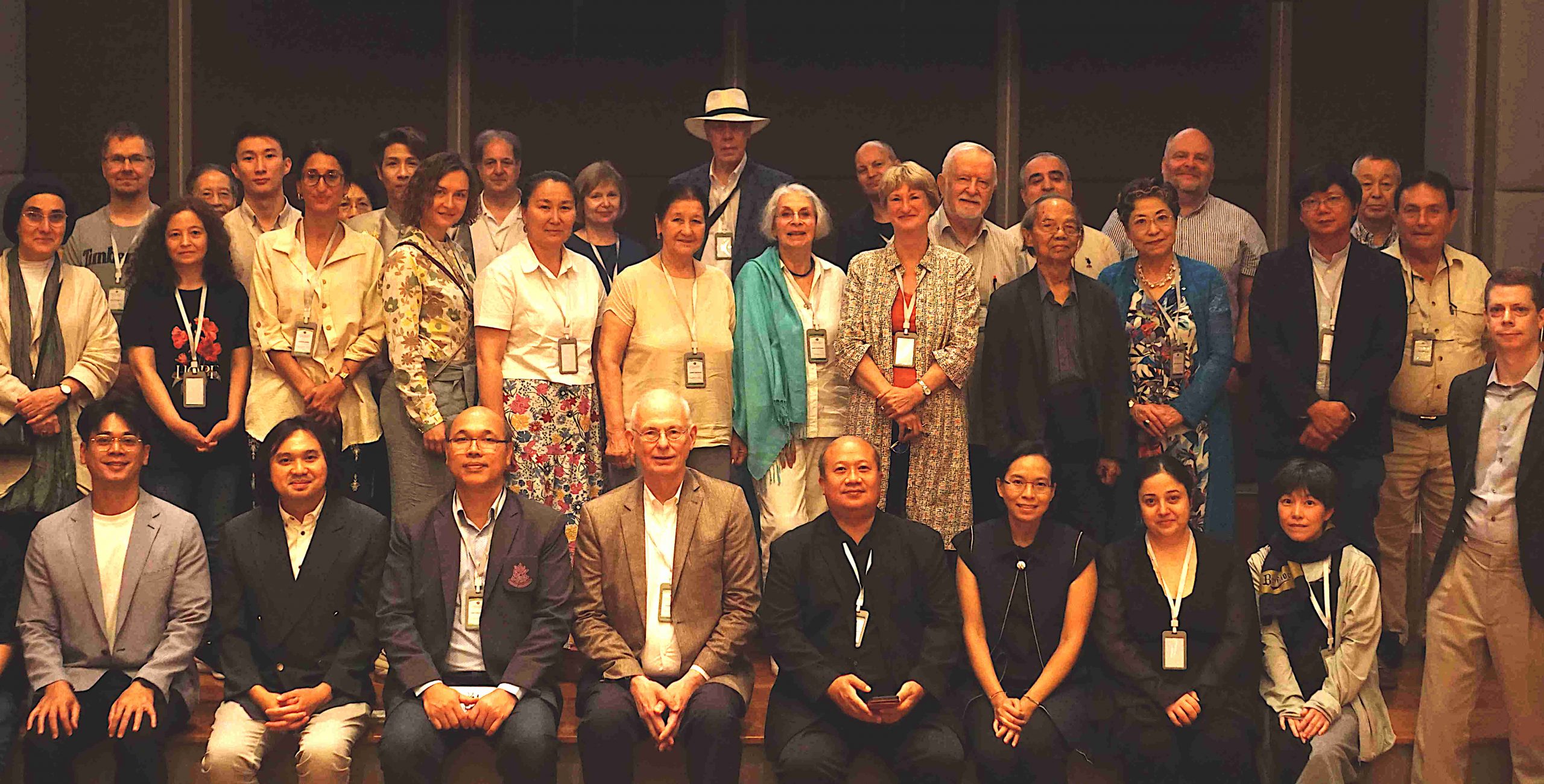
The Participants of the 68th Annual Meeting of the Permanent International Conference (PIAC), Bangkok, June 21–26, 2026
Communications
The organizers of this Annual Meeting grouped all communications under seven panels: 1) From Altai to Southern Asia, 2) Altaic aesthetics, 3) Altaic ethnography and onomastics, 4) Altaic sociolinguistics, 5) Comparative Altaic linguistics, 6) Buddhism and Altaic philosophy, and finally 7) Altaic philology. The programme lists all speakers and their contributions.
Historical Contributors to the field of Altaic Studies and the PIAC
On Tuesday, June 23, Barbara Kellner-Heinkele took the occasion of the date and introduced the German Turkologist Claus Schönig (* Oct. 23, 1955 — † June 23, 2019) to the audience, while Ákos Bertalan Apatóczky portrayed the Hungarian Mongolist György Kara (* June 23, 1935 — † April 16, 2022). Two days later, on June 25, Juha Janhunen presented the life and work of the Finnish Turkologist Martti Räsänen (* June 25, 1893 — † September 7, 1976)
Excursion
During the excursion on Wednesday, June 24, the participants of the 68th Annual Meeting of the PIAC were given a guided tour of Wat Pho or the Temple of the Reclining Buddha, its official name being Wat Phra Chetuphon Wimon Mangkhalaram Rajwaramahawihan, by a senior monk. They then visited the Bangkok National Museum, the campus of Silpakorn University and the library of Thammasat University, guided by our host Prof. Thapakorn Kamnerdsiri. The day ended with a festive meal at the restaurant of the Thai Royal Navy Club, situated on the banks of Chao Phraya River.
Business Meeting
After approval of agenda and appointment of Michal Schwarz as note-taker, Certificates of Participation were handed to every participant.
Proceedings of the 68th Annual Meeting
The organizers will send a message to all participants in early autumn of 2026 with detailed information for submitting contributions. The anticipated deadline for contributions is mid-October 2026.
Status of Proceedings of Former Meetings
The Proceedings of the 61st Annual Meeting of the PIAC, Bishkek 2018, have finally reached a decision on which papers to include; the collection of contributions had to be divided into two volumes due to contextual and linguistic factors. The volume with (mostly) English language contents will have about twenty contributions. These are currently being edited (a work which lies in the hands of the Secretary General, supported by colleagues in Bishkek) and are supposed to appear in autumn 2026.
The Proceedings of the 64th Annual Meeting of the PIAC, Budapest 2022, edited by Ákos Bertalan Apatóczky, have been finished, are currently in print and are supposed to appear soon.
The Proceedings of the 67th Annual Meeting of the PIAC, Gotemba 2025, are currently being edited, as two members of the editorial team, Junko Miyawaki-Okada and Michael Knüppel, reported. There are approx. 25 contributions to be expected, only a few contributions are still missing. A Japanese publishing house has accepted the volume.
69th Annual Meeting of the PIAC, 2027
Julie Lefort came forward and invited all participants for the 69th Annual Meeting of the PIAC. She will share the precidency with Alice Crowther at the CRLAO at Campus Condorcet in Paris. Julie Lefort provided a brief introduction to the campus and its location on the map. The theme of the 69th PIAC Meeting is “(Language) Contacts in the Altaic World,” and the expected dates are 6–11 September 2027. All participants expressed congratulations to Julie Lefort and deep thanks for taking on the hard organizational tasks.
PIAC Medal Committee
In light of the recent difficulties of financing the growing expenses for the production of the PIAC Medal, it was agreed to explore alternatives to the current PIAC Medal with the aim of reducing its cost while retaining its artistic value as a token of appreciation for the life-long dedication to Altaic Studies by the recipients of the PIAC Medal. It was agreed that the Medal cannot be reduced to a mass-produced, cheap award. One possibility was considered that the decision to award future PIAC Medals might be made depending on a minimum number of PIAC participants in a particular year.
The following three persons were elected as members of the PIAC Medal Committee: Barbara Kellner-Heinkele, Mehmet Ölmez and Junko Miyawaki-Okada. The Secretary General and the President of the next PIAC Meeting are ex officio members of the Medal Committee.
Miscellaneous
Oliver Corff, Secretary General of the PIAC, suggested that June 26 be designated as the International PIAC Day, as it is the most frequently used day of the year across all past PIAC meetings so far. Including the current Meeting, June 26 has seen eleven PIAC Meetings: the 1st, 2nd, 3rd, 10th, 13th, 21st, 33rd, 45th, 46th, 59th, and 68th Meetings. Scholars are invited to celebrate Altaic Studies and the PIAC by organizing related workshops, seminars and small ad hoc meetings on June 26.
Resolution
Be it resolved that the members assembled in the 68th Annual Meeting of the PIAC
- profoundly thank all our hosts in Bangkok: the Sanskrit Studies Centre, Faculty of Archaeology, Silpakorn University, and the Center for Korean Studies, Institute of East Asia Studies, Thammasat University, for their generous hospitality in hosting the 68th Annual Meeting of the PIAC;
- express their heartfelt gratitude to Prof. Sombat Mangmeesukhsiri, Director of the Sanskrit Studies Centre and President of the 68th Meeting, U-tain Wongsathit, Tiwa Sukhum, Supreechaya Chabchai, Kamonrat Visadsirivarrakul, Thapakorn Kamnerdsiri, Chingduang Yurayong, Sami Honkasalo and Andrew Logie for all their work and steadfast commitment that made this Meeting in Bangkok possible.
Words of Appreciation
Following a long-standing tradition, Hartmut Walravens, on behalf of all members present at the Meeting, presented a summary of the Meeting, highlighted that it was held for the first time in Southeast Asia, and expressed gratitude for the perfect organization.
With the closing remarks by the President of the 68th Annual Meeting, Sombat Mangmeesukhsiri, the Meeting formally ended.